Installing an air conditioning system in Australia is far more complex than simply mounting a unit on a wall and plugging it into a power outlet. Due to the potential environmental hazards of chemical refrigerants and the inherent safety risks of electrical wiring, the Australian federal and state governments strictly regulate who can legally carry out these installations.
Whether you’re a homeowner planning a home upgrade or a tradesperson looking to expand your services, understanding the mandatory licensing requirements for air conditioning unit installation across Australia is essential to ensure compliance, safety and warranty coverage.
Federal Regulation: The Australian Refrigeration Council (ARC)
At the national level, the primary framework governing cooling and heating systems is administered by the Australian Refrigeration Council (ARC) on behalf of the Commonwealth Department of Climate Change, Energy, the Environment and Water. Under the Ozone Protection and Synthetic Greenhouse Gas Management Act 1989, anyone who handles fluorocarbon refrigerants must hold a valid Refrigerant Handling Licence (RHL).
Refrigerants used in modern systems are powerful greenhouse gases or ozone-depleting substances. If released into the atmosphere during improper vacuuming, connection or decommissioning, they contribute significantly to global warming.
Consequently, uncertified handling carries hefty statutory penalties.
ARC issues two main categories of individual licences relevant to residential and commercial setups:
1. Full Refrigeration & Air Conditioning Licence
This comprehensive qualification (typically obtained via a Certificate III in Refrigeration and Air Conditioning) allows a technician to install, service, repair, maintain and decommission all types of cooling and refrigeration systems. This includes large multi-head split systems, ducted units, commercial chillers and transport refrigeration.
2. Restricted Split System Air Conditioning Licence
Often referred to as a restricted ARCtick licence, this pathway (typically requiring a Certificate II in Split Air Conditioning and Heat Pump Systems) allows qualified tradespeople — most commonly electricians — to install and decommission single-head split system air conditioners up to a specified capacity (usually under 18kW). It does not authorise the holder to service, repair or work on complex commercial or multi-head systems.
State & Territory Trade Licencing
Holding a federal ARC licence covers the environmental aspect of handling gases, but it does not automatically grant total permission to perform structural or electrical trade work in every state. State building regulators enforce additional trade licences to protect consumers from substandard workmanship.
The specific requirements vary depending on the jurisdiction:
-
New South Wales (NSW Fair Trading): Technicians must hold an Air Conditioning and Refrigeration Contractor Licence or Supervisor Certificate to contract for residential or commercial work exceeding legal financial thresholds.
-
Victoria (Victorian Building Authority – VBA): Installers often require a Plumbing Industry Commission endorsement in mechanical services or specialised trade registration alongside their federal credentials.
-
Queensland (Queensland Building & Construction Commission – QBCC): Contractors must hold a QBCC licence under the Refrigeration, Air Conditioning and Mechanical Services category for residential installations.
-
Other states & territories: Authorities such as Access Canberra (ACT), Consumer and Business Services (SA) and Building and Energy (WA) enforce equivalent trade licensing schemes requiring recognised qualifications.
Electrical Safety & Wiring Requirements
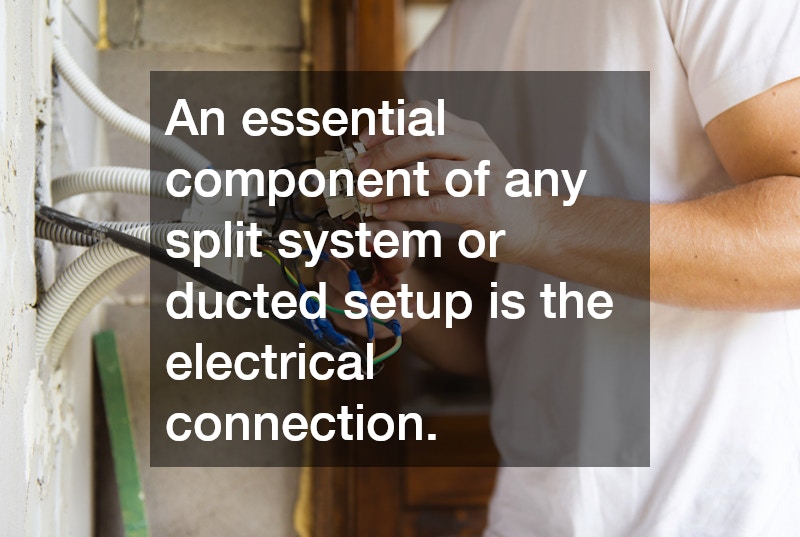
An essential component of any split system or ducted setup is the electrical connection. Modern units require a dedicated circuit from the main switchboard and a local outdoor isolator switch to allow safe maintenance.
Under Australian electrical safety standard AS/NZS 3000 (commonly known as the Wiring Rules), all fixed electrical wiring must be carried out by a licensed electrician holding an unrestricted electrical licence.
If an installer holds a restricted ARC licence but is not a licensed electrician, they cannot legally connect the system to the switchboard or run new power lines. In such cases, the installation requires two separate tradies: a certified cooling technician to mount the unit and connect pipework, and a licensed electrician to handle the electrical hardwiring and safety switches.
The Risks of DIY & Unlicensed Installations
In an attempt to cut costs, some homeowners consider DIY installations or hiring unregistered handyman services. In Australia, this carries significant financial and physical risks.
Important warning: Attempting to install a split or ducted unit without valid ARC and state trade licences is illegal in Australia. Fines for unlicensed refrigerant discharge and unauthorised electrical work can reach tens of thousands of dollars for individuals.
Beyond legal penalties, unlicensed work leads to severe consequences:
- Voided warranties: Major manufacturers explicitly state in their terms that product warranties are void unless installed by an ARC-certified professional.
- Insurance invalidation: If an improperly wired unit causes a fire or severe water damage to the home, insurance providers may reject the claim due to uncertified work.
- Inefficient performance: Poorly evacuated lines, incorrect gas charges and miscalculated ductwork lead to high electricity bills, poor cooling performance and early compressor failure.
When selecting an installer, homeowners should always ask for their ARC licence number (often displayed with an ARCtick logo) alongside their state trade contractor and electrical licence numbers before accepting a quote.